
A photograph appearing to show Donald Trump kissing his executive assistant Natalie Harp has exploded across social media, prompting speculation about the nature of their relationship.
But there is a major problem with the viral image: there is no credible evidence that the photograph is authentic.
The picture has circulated in both blurry and clearer versions, with social-media users presenting it as evidence of an intimate moment between Trump and Harp. However, the image has not been independently authenticated, and reports examining it have identified signs suggesting it may have been digitally altered or generated with artificial intelligence.
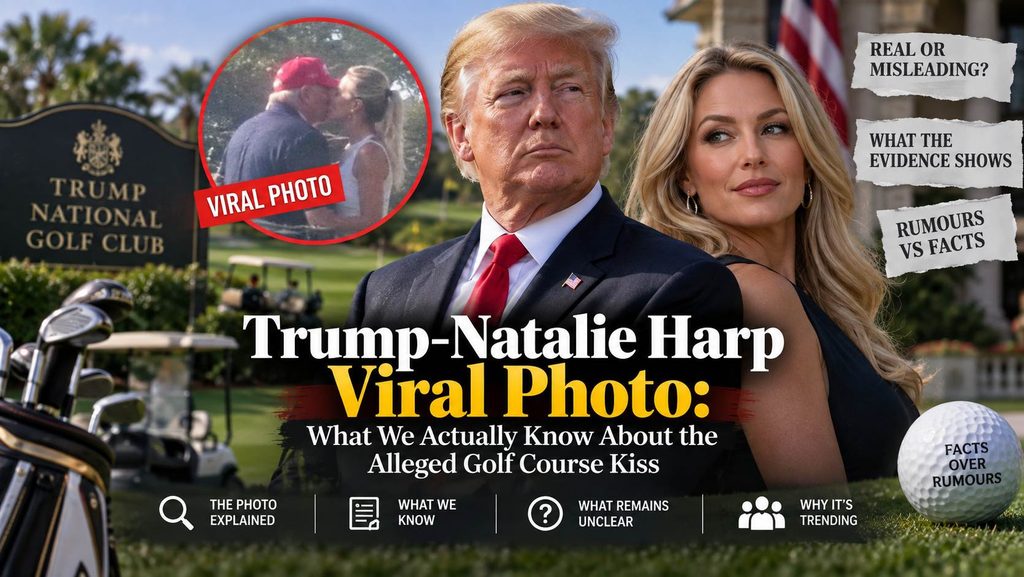
That makes the real story less about what happened on a golf course and more about how quickly an unverified image can become a widely discussed claim.
The Photo That Started the Rumor
The viral picture appears to show a man resembling Trump standing close to a blonde woman dressed in white.
The setting appears to be a golf course, with a golf cart and greenery visible in the background. The woman appears to be wearing a golf glove and holding a golf club.
At first glance, the image can look convincing enough to encourage viewers to accept the scene as genuine.
But photographs that appear convincing on a phone screen can still contain problems that become more noticeable when the image is examined closely.
The image circulating online has reportedly appeared in different versions, including a low-resolution version and a clearer version. Neither version has been independently verified as an authentic photograph.
No Verified Evidence of a Kiss
This is the most important point.
The viral photograph does not establish that Trump kissed Natalie Harp.
There is no credible source confirming that the pictured moment actually occurred, and the photograph itself has been described as unauthenticated and likely manipulated or AI-generated.
That means claims on social media about an alleged romantic relationship based solely on this image should be treated as unverified.
In an era when AI-generated photographs can create remarkably realistic scenes, the old rule of “seeing is believing” no longer works particularly well online.
A photograph needs a source, context and verification.
Why the Image Raised So Many Questions
The picture attracted attention partly because Natalie Harp is not an unknown figure within Trump’s political circle.
Harp serves as Trump’s executive assistant and has been a visible member of his inner working environment.
That makes images showing the two together more likely to attract public attention, particularly when an unusual-looking photograph appears online.
But being photographed together, traveling together or working closely together does not establish a romantic relationship.
The viral image therefore jumped from an ambiguous visual claim to much larger conclusions that the available evidence does not support.
Who Is Natalie Harp?
Harp has worked closely with Trump for years and became known publicly through her support for him.
Reuters reported earlier this month that Trump gave Harp a $25,000 cash gift in 2025, part of a total of $45,000 in cash gifts he gave to four close aides. The payments were reported by Reuters based on financial records and were described as gifts rather than compensation.
That documented financial relationship is separate from the viral photograph.
The existence of a close professional relationship between Trump and Harp is therefore established, while the alleged kiss shown in the viral image is not.
Keeping those two facts separate is essential when assessing the online claims.
How AI Has Changed the Rules of Viral Photos
A few years ago, an apparently ordinary photograph could carry considerable evidentiary weight.
Today, that assumption is increasingly risky.
Generative AI can create people, locations and interactions that never happened. It can also modify genuine photographs by changing faces, body positions, backgrounds or physical contact between people.
In the Trump-Harp image, reports have pointed to visual irregularities that raise questions about its authenticity.
That does not mean every unusual-looking photograph is automatically AI-generated.
It means that unusual images making extraordinary claims require verification before they are treated as factual evidence.
Social Media Moves Faster Than Fact-Checking
The image illustrates another problem: the speed at which social media distributes visual material.
A user can post an image with a provocative caption. Other users can repost it without checking the original source. Soon, thousands of people may be discussing what supposedly happened even though nobody can establish when, where or by whom the picture was taken.
At that stage, correcting the original claim becomes much harder.
The image can acquire a life of its own.
Some users may share it as a joke, others as political criticism and others because they genuinely believe it is authentic.
But the motivation for sharing does not change the underlying question: Is the image real?
In this case, that question remains unanswered in the affirmative.
The Difference Between a Photograph and Proof
This episode also highlights an important distinction in modern online reporting.
A photograph can be evidence, but it is not automatically proof.
Journalists normally look for the original image, metadata where available, the identity of the photographer, the date and location, other photographs from the same event and independent witnesses or reporting.
Without that context, a viral photograph is simply a claim waiting to be verified.
The Trump-Harp image currently falls into that category.
What We Can Actually Establish
There are several facts that should not be confused with the viral claim.
Trump and Harp have a documented professional relationship. Harp works as Trump’s executive assistant. Trump has also given her a reported cash gift, according to Reuters.
There are also genuine photographs and public appearances showing Harp around Trump.
But none of those facts authenticate the viral golf-course photograph or prove that the two were romantically involved.
The distinction is particularly important because the image is being used online to support claims that go far beyond what can currently be established.
Why the Story Matters Beyond Trump
The episode is bigger than one photograph or one political figure.
Public figures around the world are increasingly becoming targets of synthetic images, manipulated videos and misleading visual content.
The technology is becoming easier to use, while social platforms make distribution almost instantaneous.
That combination creates a difficult environment for readers.
An image can look like documentation while actually being fabricated.
And once millions of people have seen it, correcting the false impression becomes much harder than creating it.
A New Rule for the AI Era
The Trump-Harp photograph offers a useful lesson for anyone consuming news online.
When an image appears to reveal something sensational, the first question should not be, “What does this prove?”
It should be, “Who verified it?”
Where did the photograph originate? Is there an original source? Have reputable news organizations authenticated it? Are there other photographs from the same moment? Does the image contain technical or visual inconsistencies?
Those questions matter even more when the photograph appears to show something potentially damaging or scandalous.
The Bottom Line
The viral image purporting to show Donald Trump kissing Natalie Harp has generated widespread speculation, but the available evidence does not establish that the scene is genuine.
The photograph remains unauthenticated and has been flagged as likely manipulated or AI-generated.
Trump’s close professional relationship with Harp is documented, but that fact should not be used to validate an unrelated and unverified image.
The bigger story is therefore not a confirmed golf-course kiss.
It is a reminder of how easily a convincing picture can become a powerful rumor in the age of artificial intelligence.
When an image spreads faster than its source can be checked, the most important detail may be the one that cannot be seen in the photograph at all: where did it actually come from?


