
North Korean leader Kim Jong Un has once again put Russia at the center of Pyongyang’s foreign-policy messaging, promising to expand and deepen cooperation with Moscow while expressing confidence in what he described as Russia’s victory in its war against Ukraine.
The message, sent to Russian President Vladimir Putin as North Korea marked its 78th founding anniversary, was more than a routine diplomatic greeting. It underscored how far the relationship between Pyongyang and Moscow has developed since Russia launched its full-scale invasion of Ukraine in 2022.
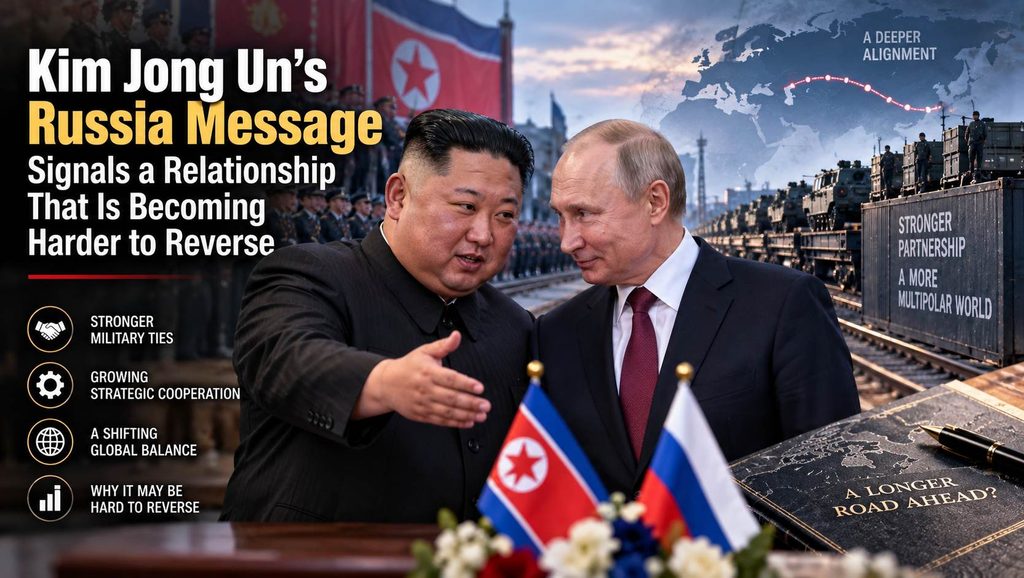
Kim described Russia’s war as a “sacred war” for national and global justice and said North Korea would continue providing unwavering support.
The wording matters because it shows that Pyongyang is not presenting its relationship with Moscow as temporary cooperation. Instead, North Korea is publicly portraying the partnership as a long-term strategic alignment.
A Relationship Built on More Than Words
North Korea and Russia have moved considerably closer over the past several years.
Their cooperation became particularly significant after the start of Russia’s full-scale war in Ukraine. The two countries signed a comprehensive strategic partnership treaty in 2024 that included a mutual-defense commitment, giving their relationship a formal security dimension.
North Korea has also acknowledged that its military personnel participated alongside Russian forces in the war.
That makes Kim’s latest message part of a much larger pattern.
Rather than simply offering diplomatic support from afar, Pyongyang has increasingly become involved in Russia’s war effort, while Moscow and Pyongyang have expanded cooperation across security and other areas.
Why Moscow Matters to Pyongyang
For North Korea, closer ties with Russia provide an alternative source of diplomatic, economic and potentially technological cooperation at a time when Pyongyang remains heavily constrained by international sanctions.
Russia, meanwhile, has its own reasons for maintaining the relationship.
The war in Ukraine has increased Moscow’s need for military supplies and international partners willing to cooperate despite Western pressure. North Korea has emerged as one of those partners.
The relationship therefore has a practical foundation beneath the political rhetoric.
It is not simply about Kim supporting Putin.
Both governments have interests that overlap.
Ukraine Has Changed the Equation
Before Russia’s invasion of Ukraine, Moscow maintained relations with both North Korea and South Korea while participating in international efforts related to the North Korean nuclear issue.
The war dramatically altered that balance.
Russia’s confrontation with Western countries has brought Moscow closer to governments that oppose or reject Western pressure. North Korea is one of them.
Pyongyang, in turn, has gained a powerful diplomatic partner that holds a permanent seat on the United Nations Security Council.
That creates an important political connection.
North Korea has long faced international sanctions over its nuclear and missile programs. Its closer relationship with Russia has complicated the diplomatic environment surrounding those sanctions and broader efforts to pressure Pyongyang.
Military Cooperation Is at the Center
The most consequential part of the relationship is arguably military cooperation.
Western governments and South Korea have reported that North Korea supplied Russia with large quantities of ammunition and other military assistance. North Korean troops have also participated in the conflict on Russia’s side.
Kim publicly acknowledged North Korean troops fighting alongside Russian forces in 2025, after Pyongyang had initially denied direct involvement.
That history gives additional weight to Kim’s latest promise of support.
His message is not simply expressing sympathy for Moscow’s position. It comes after the two countries have already developed direct military cooperation.
What Does Russia Give North Korea?
The relationship also raises questions about what Pyongyang receives in return.
Russia has resources, technology, diplomatic influence and access to energy and other economic links that could be valuable to North Korea.
Western and South Korean officials have repeatedly expressed concern that cooperation with Russia could provide North Korea with assistance relevant to its military capabilities.
The exact scope of such cooperation is difficult to establish publicly, however, and claims about specific transfers or technologies often come from governments involved in the geopolitical dispute.
What is clear is that both sides have found reasons to deepen the relationship.
China Is Still Important
Kim’s message to Putin also came alongside similar outreach to Chinese President Xi Jinping.
That detail is significant.
North Korea is not abandoning China for Russia. Beijing remains North Korea’s most important traditional economic partner and a major political relationship.
Instead, Pyongyang appears to be maintaining relationships with both major powers.
For North Korea, having stronger connections with Russia and China provides more diplomatic room at a time when relations with the United States and South Korea remain deeply strained.
The result is a three-way regional dynamic involving Pyongyang, Moscow and Beijing, with Washington, Seoul and Tokyo closely watching developments.
A Different Kind of Strategic Partnership
The Russia-North Korea relationship is unusual because both countries face substantial international pressure but possess very different resources and strategic needs.
Russia has a much larger economy, extensive natural resources and a major military-industrial base.
North Korea has a large military, significant stocks of conventional ammunition and a strategic weapons program, but a much smaller economy.
Their cooperation can therefore be complementary.
North Korea can offer resources that Russia finds useful, while Russia has capabilities and resources that can be valuable to Pyongyang.
This does not mean the two countries have identical interests.
But their shared opposition to Western pressure gives them a strong reason to cooperate.
Kim’s Language Sends a Message Beyond Moscow
Kim’s description of Russia’s war as a “sacred war” is also aimed at audiences beyond Putin.
North Korean state messaging frequently frames international conflicts through the language of sovereignty, resistance and confrontation with what Pyongyang calls hostile external forces.
By adopting similar language for Russia’s war, Kim is reinforcing a broader narrative in which North Korea and Russia are portrayed as defending themselves against Western pressure.
That framing is rejected by Ukraine and its Western allies, which regard Russia as the aggressor in the war.
The difference in these narratives illustrates just how sharply divided the international debate over the conflict remains.
The Bigger Question Is How Far the Partnership Goes
Kim’s latest pledge does not by itself announce a new military agreement or a specific new weapons transfer.
Its importance lies elsewhere.
It confirms that Pyongyang continues to view Moscow as a long-term strategic partner.
The relationship has already moved beyond ceremonial diplomacy. It has developed treaties, military cooperation and increasingly frequent high-level exchanges.
That makes the future direction of the partnership important for the wider security environment in Europe and East Asia.
A Partnership With Two Battlefields
The consequences of the Russia-North Korea relationship are being felt in two very different regions.
In Europe, North Korean support can affect Russia’s ability to sustain its war effort against Ukraine.
In East Asia, deeper Russian-North Korean cooperation raises questions about the security environment surrounding the Korean Peninsula.
South Korea, Japan and the United States therefore have reasons to monitor the relationship closely.
Any expansion of military or technological cooperation could potentially affect calculations far beyond the Russian-Ukrainian battlefield.
The Message From Pyongyang Is Clear
Kim Jong Un’s latest message to Vladimir Putin does not necessarily reveal every detail of what Russia and North Korea may do next.
But it does remove much of the ambiguity surrounding Pyongyang’s political position.
North Korea continues to support Moscow and says it intends to deepen cooperation.
The relationship that emerged from the geopolitical upheaval of the Ukraine war is now becoming an established part of both countries’ foreign-policy strategies.
For Russia, North Korea represents an important partner at a time when Moscow remains under extensive Western pressure.
For North Korea, Russia offers another powerful relationship alongside its longstanding ties with China.
And for the rest of the world, the development signals that the consequences of the Ukraine war are extending well beyond Europe.
The battlefield may be thousands of miles away from the Korean Peninsula, but the alliances and partnerships created by the conflict are changing the strategic landscape in Asia as well.
Kim’s latest message is therefore less about a single anniversary statement and more about the durability of a relationship that has been steadily moving from diplomatic friendship toward practical strategic cooperation.


