
Asia’s billionaire rankings have undergone another major shift, and this time the change highlights a much bigger transformation taking place in the region’s economy.
Zhang Yiming, the founder of ByteDance, the Chinese technology company behind TikTok, has overtaken Indian industrialist Gautam Adani to become Asia’s richest person, according to the Bloomberg Billionaires Index.
Zhang’s estimated fortune has crossed $105 billion, placing him ahead of Adani and marking his first appearance at the top of Bloomberg’s Asia wealth ranking.
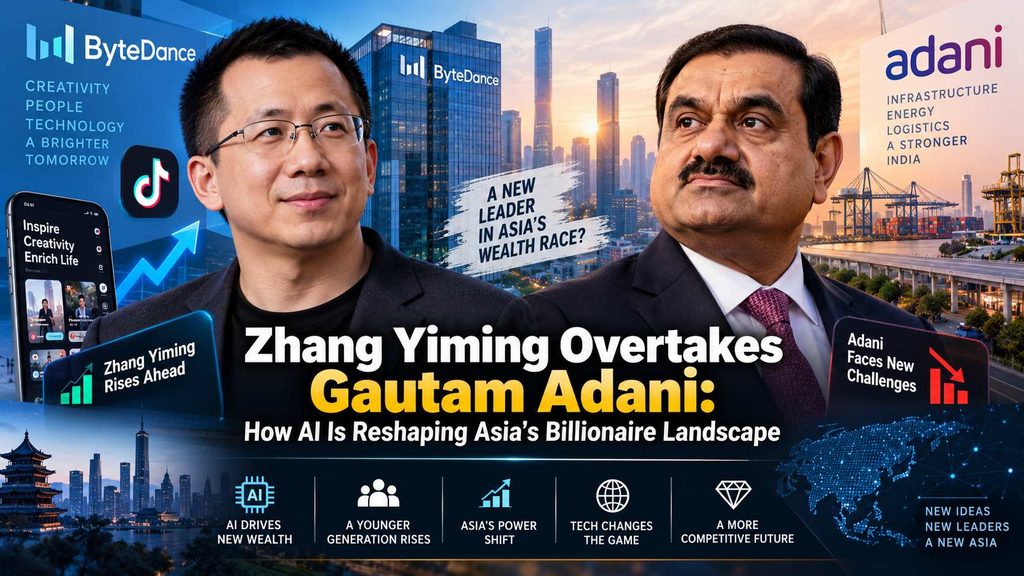
The development is striking because Zhang’s wealth is closely connected to technology, social media and artificial intelligence, while Adani built his fortune across infrastructure, energy, ports and other traditional industries.
The changing order offers a snapshot of where investors are placing some of their biggest bets in Asia.
From TikTok to the Top of Asia
Zhang Yiming founded ByteDance in 2012, long before TikTok became one of the world’s most recognizable social-media platforms.
TikTok eventually transformed the company’s global profile, but ByteDance has expanded well beyond short-form video.
Its artificial-intelligence businesses have increasingly become part of the company’s growth story. ByteDance operates AI products including the Doubao chatbot and Seedance, its AI video-generation technology.
That expansion has helped reshape how investors view the company and, consequently, the value of Zhang’s stake.
In June, Bloomberg’s index placed Zhang at about $92.8 billion, making him Asia’s second-richest person behind Adani. At that time, Zhang had already overtaken Reliance Industries chairman Mukesh Ambani.
Just a few months later, the ranking has changed again.
AI Has Become a Wealth Engine
The most important part of Zhang’s rise may not be TikTok itself.
It is the growing value investors are attaching to artificial intelligence.
ByteDance is increasingly positioning itself as an AI company as well as a social-media company. Its AI ambitions have created another growth narrative around a business that was already one of China’s most valuable private technology companies.
That matters because billionaire wealth is closely tied to asset valuations.
When the value of a company rises, the estimated wealth of its major shareholders can rise dramatically even if they have not sold additional shares.
Zhang’s jump therefore illustrates something important about modern fortunes: the biggest changes in billionaire rankings can happen when markets change their expectations about the future.
A Dramatic Change From 2019
The scale of Zhang’s rise becomes clearer when viewed over a longer period.
Bloomberg began tracking his wealth at around $13 billion in March 2019. His estimated fortune has now climbed above $105 billion.
That is an increase of more than eight times.
The transformation reflects the extraordinary expansion of ByteDance and the global reach of its products.
TikTok became a major cultural and commercial platform across numerous countries, while ByteDance continued investing in other technologies and AI applications.
Zhang stepped down as ByteDance’s chief executive in 2021, but his wealth remains closely tied to the company’s value.
Adani’s Position Has Changed
Gautam Adani’s move down the ranking tells a different story.
The change does not necessarily mean Adani’s businesses have suddenly become less important. Rather, billionaire rankings are relative and can change because of movements in both individuals’ estimated fortunes.
Adani’s wealth is linked heavily to publicly traded companies and large businesses exposed to energy, infrastructure, commodities and financial markets.
Those sectors can experience very different valuation cycles from technology companies.
As Zhang’s estimated fortune climbed above $105 billion, Adani slipped behind him in Bloomberg’s latest ranking.
The result is a symbolic change in the regional wealth map.
The Bigger Shift: Infrastructure Versus Algorithms
There is an interesting contrast between the two fortunes.
Adani represents a model of wealth built around physical infrastructure: ports, airports, energy, logistics and industrial assets.
Zhang represents a model built around software, digital platforms and increasingly AI.
Neither model has replaced the other.
Asia still needs ports, power plants, transportation networks and energy infrastructure. At the same time, software and AI companies can scale across borders at remarkable speed.
The changing billionaire rankings simply show that investors are assigning enormous value to both types of assets—and that technology valuations can move extraordinarily quickly.
China’s AI Story Is Becoming More Important
Zhang’s rise also reflects the broader development of China’s technology sector.
Chinese companies have been investing heavily in artificial intelligence, competing across areas ranging from foundation models and chatbots to autonomous systems, robotics and AI-generated media.
ByteDance’s own AI products are part of this wider ecosystem.
The company has developed Doubao as an AI assistant and has invested in generative AI tools such as Seedance.
That means Zhang’s fortune is no longer simply a reflection of TikTok’s popularity.
It increasingly reflects expectations about what ByteDance can build in the next generation of computing.
Why TikTok Still Matters
Despite the growing focus on AI, TikTok remains central to the story.
The app transformed short-form video and gave ByteDance a global consumer platform with enormous reach.
That global footprint helped make ByteDance one of the world’s most valuable technology companies.
TikTok also provided ByteDance with something extremely valuable in the technology industry: huge amounts of user engagement and a global distribution network.
AI products can benefit from having an established ecosystem through which new services can be developed and distributed.
The combination of social media and AI therefore gives ByteDance a different position from many standalone AI companies.
Zhang Is Not Running ByteDance Day to Day
Another detail often lost in the billionaire headline is that Zhang is no longer ByteDance’s chief executive.
He stepped down from the CEO position in 2021 and later relinquished the chairmanship as part of the company’s leadership transition.
His wealth nevertheless remains connected to his ownership interest in the company.
This distinction matters because billionaire rankings measure estimated wealth, not executive salaries or annual income.
A founder can become enormously wealthy from owning a stake in a company without personally running its daily operations.
Billionaire Rankings Are Moving Targets
It is also important not to treat the $105 billion figure as a fixed bank balance.
Bloomberg’s Billionaires Index estimates individual fortunes using asset values, company valuations and other financial information.
Those numbers can change quickly.
A movement in a company’s share price, a change in a private company’s valuation or currency fluctuations can alter the ranking.
That means Zhang’s position at the top of Asia’s wealth table could change again.
But the broader trend remains significant even if the exact ranking changes tomorrow.
India’s Billionaire Landscape Is Still Massive
Zhang’s rise should not be interpreted as a collapse of India’s position in Asia’s technology or business economy.
India remains home to some of the region’s largest corporations and fortunes.
Mukesh Ambani had already been overtaken by Zhang in June, when Zhang reached $92.8 billion and became Asia’s second-richest person.
The latest development simply adds another change at the top.
Adani’s position demonstrates how quickly rankings can move when market valuations shift.
For investors and businesses, the more relevant question is therefore not who holds the No. 1 spot on a particular day, but which sectors are generating the strongest expectations for future growth.
The New Wealth Race Is About What Comes Next
For years, some of Asia’s largest fortunes were associated with sectors such as oil, telecommunications, manufacturing, property and infrastructure.
Technology changed that equation.
Now artificial intelligence is accelerating the transformation.
Zhang’s rise shows how quickly a technology entrepreneur can accumulate a fortune when a private company becomes a global platform and then adds a new AI growth story.
The same trend can be seen across global markets, where investors have placed enormous valuations on companies developing chips, AI models, cloud infrastructure and software.
AI is not simply producing new products.
It is changing how markets value companies—and, as a result, how fortunes are created.
What Zhang’s Rise Really Tells Us
The headline may be about Zhang Yiming overtaking Gautam Adani.
But the deeper story is about the changing definition of economic power in Asia.
A decade ago, it would have been difficult to imagine a social-media entrepreneur becoming the continent’s richest individual through a company whose most famous product is a smartphone video app.
Today, that is exactly what has happened.
And the fact that the same company is now investing heavily in AI makes the story even more significant.
Zhang’s fortune has risen alongside ByteDance’s expanding technology ambitions, while Adani’s ranking has shifted as the valuations of his business interests have changed.
The result is more than a billionaire leaderboard update.
It is a snapshot of a broader economic transition.
Asia’s wealth map is increasingly being shaped not only by who owns physical assets, but also by who controls platforms, data, software and artificial intelligence.
Zhang Yiming’s rise to the top of the regional ranking is one of the clearest recent examples of that transformation.


