
India’s hugely popular UPI payment system is entering a new phase—and the change has quickly become a political flashpoint.
Congress leader and Leader of the Opposition in the Lok Sabha Rahul Gandhi has urged Prime Minister Narendra Modi to withdraw what he calls an “UPI tax,” arguing that the government’s new framework could eventually make digital payments more expensive for ordinary Indians.
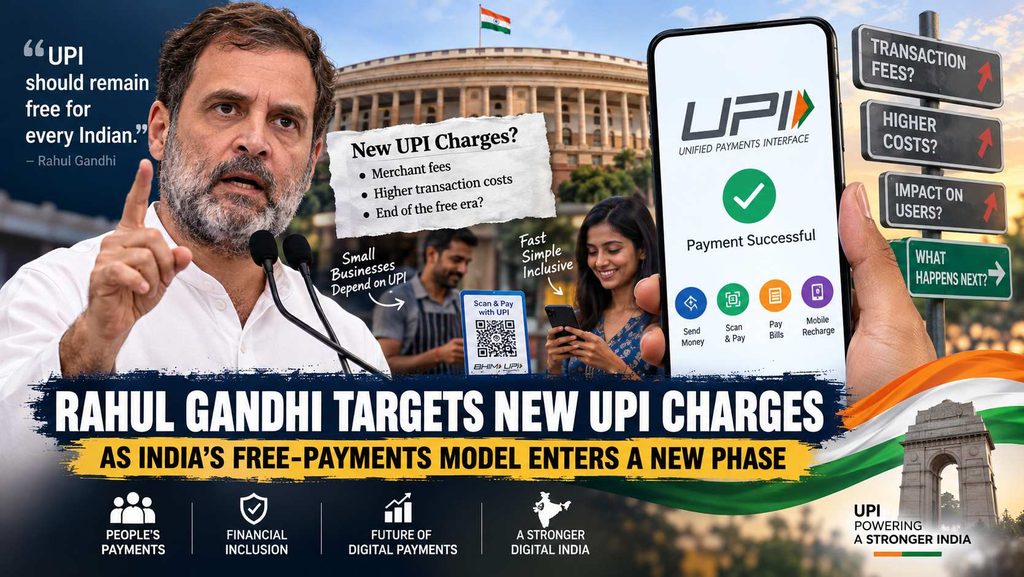
The government, however, describes the measure differently. It says the new system introduces a limited Merchant Discount Rate (MDR) on certain higher-value merchant transactions while keeping person-to-person UPI payments free and protecting most smaller transactions from charges.
The disagreement is therefore not simply about whether UPI remains free. It is about who ultimately bears the cost of running and expanding one of the world’s largest real-time payment systems.
What Has Actually Changed?
Under the new framework, beginning October 15, 2026, a 0.4% MDR will apply to specified UPI payments made from customers to merchants when the transaction exceeds ₹2,000.
For transactions of ₹75,000 or more, the MDR will be capped at ₹300.
But there is an important distinction: the MDR is not a direct fee imposed on the customer.
Person-to-person UPI transfers remain free regardless of the amount. Payments to merchants up to ₹2,000 also remain free, while qualifying small merchants receiving up to ₹1 lakh per month through UPI QR codes retain zero-MDR status.
The government says around 96% of merchant transactions will remain unaffected by the new MDR framework.
That makes the phrase “UPI tax” politically powerful, but technically different from what the new rules actually establish.
Why Rahul Gandhi Is Objecting
Rahul Gandhi has argued that the distinction between a merchant fee and a consumer fee may not provide enough protection in practice.
His argument is straightforward: if businesses face a new cost for accepting certain UPI payments, some may eventually try to recover that expense through the prices they charge customers.
In his criticism, Gandhi described the new arrangement as opening the door to UPI charges and asked Modi to roll it back. He also linked the policy to what he described as pressure from American payment companies and invoked the legacy of former Prime Minister Indira Gandhi in his political attack.
Those claims about US pressure are political allegations by Gandhi, rather than an established fact. The government’s stated rationale is different: it says UPI needs a sustainable revenue model to support cybersecurity, fraud prevention, infrastructure and continued expansion.
The Government’s Argument: UPI Cannot Run on Growth Alone
UPI has grown at extraordinary speed.
The government says the system processed 2,366 crore transactions worth ₹29.9 lakh crore in July 2026 alone.
Such scale creates its own costs.
Payment networks require servers, security systems, fraud monitoring, technical upgrades and constant investment. As digital payments become more deeply embedded in everyday commerce, failures or security weaknesses can have consequences across the economy.
The government argues that relying indefinitely on subsidies to support a rapidly expanding payment ecosystem is not a sustainable model.
The new MDR framework is therefore being presented as a way of making at least part of the system financially self-sustaining.
But Why Is the Word “Tax” So Controversial?
Calling the measure a “tax” changes how people understand it.
A tax is normally collected by the government to finance public expenditure. MDR, by contrast, is a payment-processing charge within the merchant ecosystem.
According to the Finance Ministry, MDR will be distributed among participating banks, payment service providers and UPI application providers rather than collected by the government as tax revenue.
That is an important technical distinction.
However, the political argument does not disappear because the fee is technically called MDR.
The real consumer question is different:
If merchants have to pay more, will some of them eventually increase prices?
The government has instructed banks to ensure merchants do not pass MDR charges directly to customers and has prohibited UPI providers from imposing platform or hidden charges on users.
Whether businesses absorb the cost or adjust their pricing over time is a separate economic question.
Small Merchants Get Special Protection
The new rules are designed to prevent the smallest businesses from carrying the burden.
Merchants classified under the relevant small-merchant framework and receiving up to ₹1 lakh a month through UPI QR payments will continue to receive zero-MDR treatment.
That includes many neighborhood stores, street vendors and other small businesses.
The framework also provides a special flat MDR of ₹5 for qualifying payments above ₹2,000 in sectors such as railways, telecommunications, insurance, fuel and agricultural inputs.
The intention, according to the government, is to avoid placing percentage-based costs on businesses operating with narrow margins.
High-Value Payments Are Where the Debate Begins
The new system is primarily aimed at larger merchant payments.
A customer buying a few groceries through UPI is generally outside the new MDR threshold.
But a large purchase from a merchant can fall within the new framework.
That creates a new economic calculation for businesses that have increasingly relied on UPI as an inexpensive alternative to cards and other payment systems.
For payment companies and banks, the change could create a new source of revenue.
For merchants, it creates a new operating cost.
For consumers, the immediate rules say there should be no direct UPI charge—but the longer-term question is whether merchant pricing changes.
Rahul Gandhi Is Turning That Question Into a Larger Political Fight
Gandhi’s criticism goes beyond the mechanics of MDR.
He has connected the UPI debate to his broader criticism of the Modi government’s economic and foreign-policy decisions, including allegations that Washington has influenced Indian policy.
He has also compared the issue with previous political controversies and invoked Indira Gandhi as part of his appeal.
These are political arguments, not findings established by the MDR notification itself.
The government’s explanation focuses instead on payment-system sustainability, security and investment.
That difference in framing is important because the same policy can be described in two very different ways.
One side sees a new merchant cost that could eventually affect consumers.
The other sees a limited payment-industry fee designed to keep UPI financially viable while preserving free access for individuals.
The UPI Model Is Changing—But Not Disappearing
For years, one of UPI’s biggest attractions has been its simplicity.
Scan a QR code. Enter an amount. Pay.
There was no visible transaction fee for the customer, regardless of whether the payment was ₹100 or ₹50,000.
The new framework introduces a more complicated structure.
Some transactions remain completely free.
Some larger merchant payments attract MDR.
Small merchants receive exemptions.
Certain essential sectors receive special treatment.
Person-to-person transfers remain free.
That may make the payment ecosystem more financially sustainable, but it also means the once-universal idea of “free UPI” is becoming more nuanced.
What Happens to Person-to-Person Payments?
For ordinary users, this is one of the most important parts of the government’s clarification.
Sending money to another individual through UPI remains free, regardless of the transaction amount.
There are also no new monthly quotas or charges for individuals under the MDR framework.
So the new policy should not be understood as a blanket charge on every UPI transaction.
The distinction between person-to-person payments and person-to-merchant payments is central to understanding the change.
The Bigger Question: Who Pays for India’s Digital Payment Revolution?
The political controversy may eventually move beyond Rahul Gandhi’s “UPI tax” phrase.
The deeper issue is the economics of digital infrastructure.
India has built an enormous real-time payment network and encouraged businesses and consumers to adopt it at extraordinary speed.
Now someone has to finance the next stage: cybersecurity, fraud prevention, technical capacity, rural expansion and continued innovation.
The government believes part of that cost should be recovered through merchant-side MDR on selected transactions.
Critics worry that even if consumers are not charged directly, merchants may eventually find ways to incorporate the cost into their businesses.
Both questions can exist at the same time.
The Indira Gandhi Reference Adds a Political Layer
Rahul Gandhi’s invocation of Indira Gandhi places the UPI dispute within a much larger political narrative.
Rather than treating the issue as a narrow technical change to payment processing, the Congress leadership is presenting it as part of a debate over economic sovereignty, government policy and the direction of India’s digital economy.
The BJP and government representatives have rejected the Congress’ characterization of the move and have emphasized that ordinary users will not be charged.
That political contest is likely to continue as the October implementation date approaches.
What Users Should Actually Know
For ordinary UPI users, the practical takeaway is relatively simple.
Sending money to another person remains free.
Merchant payments up to ₹2,000 remain free.
Qualifying small merchants remain protected by zero-MDR provisions.
The new 0.4% MDR applies to specified merchant transactions above ₹2,000, with a ₹300 cap for transactions of ₹75,000 and above.
And under the government’s rules, the MDR is not supposed to be directly passed on to customers.
The more difficult question is what businesses will do with the additional cost over time.
UPI Has Entered a New Economic Chapter
Rahul Gandhi’s demand to roll back what he calls the “UPI tax” has turned a technical payment-system reform into a national political argument.
But beneath the political language lies a significant economic transition.
India’s digital payment revolution was built around rapid adoption and extremely low visible costs. Now policymakers are trying to create a revenue structure capable of supporting that system as it becomes larger and more complex.
The immediate rules do not introduce a blanket tax on UPI users.
They do, however, end the previous assumption that every merchant-side UPI transaction will necessarily remain outside MDR.
That is the real change.
And as October 15 approaches, the most important test will not simply be whether UPI remains popular. It will be whether India can introduce a sustainable revenue model without undermining the low-cost, convenient payment experience that helped make UPI a national habit in the first place.


