
Before a new iPhone reaches store shelves, the internet usually gets an early look at it through leaks, renders, dummy units and 3D models. That happened again with Apple’s 2026 lineup when 3D models of the iPhone Duo, iPhone 18 Pro and iPhone 18 Pro Max appeared in GSMArena’s database.
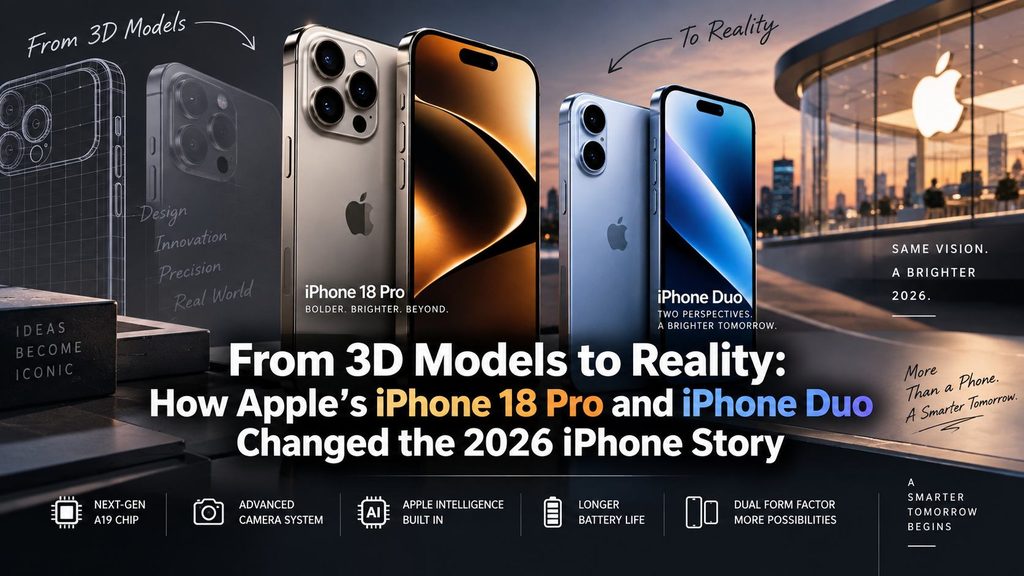
At the time, the models offered enthusiasts an opportunity to examine the expected dimensions and designs of Apple’s next-generation devices before the official announcement.
Now, however, the situation is very different.
Apple has officially introduced the iPhone Duo, iPhone 18 Pro and iPhone 18 Pro Max, turning what once looked like leaked designs into real products. The company’s September 2026 launch also represented a significant change in the traditional iPhone release strategy, with Apple focusing its fall event on its premium models and its first foldable iPhone.
The interesting story is therefore no longer simply that 3D models became available.
It is how accurately those early digital representations captured a lineup that would ultimately mark one of Apple’s more important iPhone transitions.
3D Models Offered an Early Look
3D phone models are useful because they allow people to examine a device from almost every angle.
Instead of looking at a single leaked photograph, users can rotate a model, inspect its proportions and compare it with previous generations.
For phone enthusiasts, that can reveal whether a new model is actually changing significantly or simply refining an established design.
The GSMArena database listing for the iPhone Duo, iPhone 18 Pro and iPhone 18 Pro Max arrived during that pre-launch period, giving readers another way to visualize Apple’s upcoming hardware.
But a 3D model is not the same as an official specification.
That distinction matters because pre-release models can be based on leaks, manufacturer information, CAD files or other unofficial sources.
The real specifications only become certain once Apple announces the products.
Apple Has Now Made the Designs Official
Apple’s September announcement removed much of that uncertainty.
The iPhone 18 Pro and iPhone 18 Pro Max are official products, while the iPhone Duo has become Apple’s first foldable iPhone.
The Duo is particularly important because it represents a new product category for Apple.
When opened, the foldable provides a 7.6-inch internal display, giving users a much larger screen than a conventional smartphone while retaining a more compact form when folded.
That makes the 2026 lineup more interesting than a routine annual processor or camera upgrade.
Apple is now competing in a market where the form factor itself is part of the product strategy.
The iPhone 18 Pro Is More Than a Design Refresh
The Pro models also bring significant hardware changes.
Apple says the iPhone 18 Pro and iPhone 18 Pro Max feature a new 48MP Fusion main camera with variable aperture.
That is one of the more notable camera changes because variable aperture allows the camera to physically adjust how much light reaches the sensor.
In practical terms, this gives the camera greater control over different lighting conditions and can provide more flexibility for photography.
Apple has also added new Pro controls to the Camera app, giving users more control over the way photographs are captured.
So while the external appearance remains recognizably iPhone, some of the important changes are happening underneath the surface.
The Camera Becomes a Bigger Part of the Upgrade
For several generations, smartphone camera improvements have often focused on sensors, computational photography and software processing.
The iPhone 18 Pro’s variable-aperture system takes another approach.
Instead of relying entirely on software to compensate for different lighting conditions, Apple has introduced a physical adjustment to the main camera.
That could make the camera more versatile for people who photograph in changing environments.
It also gives Apple another way to distinguish its Pro models from less expensive iPhones.
For users who care about photography, the important question is no longer simply how many megapixels a phone has.
It is how much control the entire camera system provides.
A New Chip Powers the Pro Models
The iPhone 18 Pro and Pro Max also introduce Apple’s new-generation A20 Pro chip.
The processor is designed to improve performance and efficiency while supporting the increasingly important AI features built into iOS.
Apple is positioning the devices around Apple Intelligence and a more capable Siri experience, making on-device and personal AI an increasingly important part of the iPhone experience.
This reflects a broader industry shift.
The smartphone race is no longer only about faster processors.
Companies are increasingly competing over how intelligently those processors can handle photography, voice commands, personalization and generative AI tasks.
Battery Life Is Another Major Focus
Apple has also emphasized battery improvements, particularly on the iPhone 18 Pro Max.
The company describes the new Pro Max as delivering its largest increase in battery life to date, helped by improvements in Apple silicon and a larger battery.
That is significant because longer battery life can affect everyday use more than a small performance increase.
A phone that lasts longer during video recording, gaming, navigation or heavy AI use can provide a more noticeable benefit than a specification that only appears impressive on paper.
The Foldable iPhone Changes the Conversation
The biggest surprise in the 2026 lineup is arguably the iPhone Duo.
Apple has spent years watching competitors experiment with foldable phones. With the Duo, Apple has finally entered that category itself.
The device has a 7.6-inch inner display and is designed to provide a larger workspace for activities such as gaming, viewing content and multitasking.
This gives Apple a product that sits between the traditional smartphone and a small tablet.
It also means consumers now have a fundamentally different iPhone form factor to consider.
Why the 3D Models Were Significant
Looking back, the appearance of 3D models in databases was more than an opportunity for fans to explore leaked designs.
It reflected how smartphone development has become increasingly transparent before launch.
Today, detailed CAD-based information can circulate long before a company officially reveals a product.
That changes the way technology launches work.
By the time Apple walks onto a stage, consumers may already have a strong idea of what the hardware will look like.
The official launch then becomes less about revealing the shape of the phone and more about explaining why the new hardware matters.
Apple Also Changed Its Launch Strategy
Another major development in 2026 was Apple’s decision not to release the standard iPhone 18 alongside the Pro models in the traditional September launch.
Apple instead focused on the iPhone 18 Pro, iPhone 18 Pro Max and iPhone Duo. Reports indicate that the standard iPhone 18 is expected later, potentially in spring 2027.
That creates a different product cycle.
Instead of presenting the entire iPhone family at once, Apple is separating its premium models from the mainstream lineup.
For consumers, this means the meaning of “new iPhone” is becoming less straightforward.
There may now be multiple launch windows and different hardware tiers arriving at different times.
The Real Story Is Apple’s Changing iPhone Strategy
Taken together, the iPhone Duo and iPhone 18 Pro models show that Apple is experimenting on several fronts simultaneously.
The Pro models push camera technology, processing power and battery life.
The Duo changes the physical form factor.
And the staggered launch strategy changes when consumers can expect different members of the iPhone family.
That is a much bigger story than a database update.
The 3D models were simply an early glimpse into that transition.
From Rumor to Reality
When GSMArena added the 3D models, they gave technology enthusiasts another way to explore what Apple might be preparing.
Today, there is no need to speculate about whether the iPhone 18 Pro or iPhone Duo exists.
They are official.
Apple has confirmed the iPhone 18 Pro and Pro Max, with their new camera systems, A20 Pro platform and battery improvements. It has also officially entered the foldable-phone market with the iPhone Duo.
That makes those early 3D models an interesting snapshot of the period just before Apple’s biggest 2026 hardware announcement.
The Bigger Picture
The more important lesson from the story is how quickly smartphone news moves.
A 3D model that looks like a major leak one day can become an outdated piece of information within weeks once the manufacturer makes its official announcement.
In Apple’s case, the final story turned out to be broader than simply another iPhone generation.
The company introduced a new foldable category while significantly upgrading its Pro phones.
The iPhone 18 Pro and Pro Max now represent Apple’s traditional premium smartphone approach, while the iPhone Duo represents a new direction altogether.
And that is why the old 3D-model story remains interesting.
It was not just a preview of new phones. It was an early glimpse of Apple changing what its iPhone lineup could look like.


