
Saudi Arabia has spent years trying to build an economy that is less dependent on crude oil. Now, a newly announced discovery in the Madinah region could give that strategy another major resource to work with.
Saudi Energy Minister Prince Abdulaziz bin Salman has announced that geological exploration at the Jabal Sayid project has identified an estimated 110 million tonnes of ore containing high concentrations of rare-earth elements, particularly heavy rare earths, alongside promising concentrations of uranium.
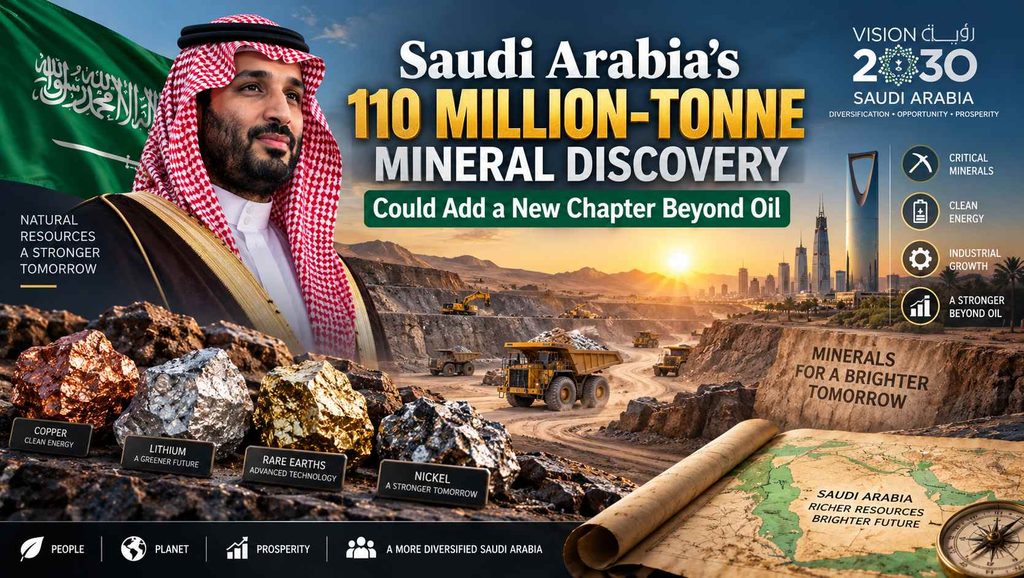
The announcement was made during the International Atomic Energy Agency’s General Conference in Vienna.
The headline number is enormous, but there is an important detail that should not be overlooked: 110 million tonnes is the estimated quantity of ore, not 110 million tonnes of uranium or rare-earth elements.
That distinction changes how the discovery should be understood.
The real significance may lie in what Saudi Arabia can eventually recover from that ore—and whether it can turn the resource into a domestic industrial supply chain.
A Discovery That Goes Beyond Oil
For decades, Saudi Arabia’s global economic influence has been closely associated with petroleum.
But Riyadh’s long-term economic strategy is increasingly focused on developing mining, manufacturing, technology and other industries alongside energy.
The Jabal Sayid announcement fits directly into that strategy.
Saudi officials are looking beyond simply extracting raw minerals. The stated ambition is to develop an integrated chain covering exploration, mining, processing, separation and refining. That could eventually include rare-earth oxides and uranium products if the economics and technical conditions support commercial production.
That would represent a very different role for Saudi Arabia in global commodity markets.
Instead of being known primarily as a producer of oil, the kingdom could increasingly become a supplier of materials used in advanced manufacturing and energy technologies.
Why Heavy Rare Earths Matter
Rare-earth elements are a group of metals used in numerous modern technologies.
They are important for permanent magnets, electric vehicles, electronics, renewable-energy equipment and other advanced industrial applications.
But not all rare earths are equally common or equally valuable.
The Saudi announcement specifically highlighted heavy rare-earth elements, which are generally less abundant and can be particularly important for high-performance applications.
That makes the composition of the Jabal Sayid ore potentially more significant than the headline tonnage alone suggests.
However, the precise grades and recoverable quantities have not been fully disclosed publicly. Until those details are established, the discovery should be viewed as a potentially important resource rather than a ready-made supply of refined rare-earth materials.
And Then There Is Uranium
The other major component is uranium.
Saudi Arabia has been pursuing the development of domestic uranium resources as part of its plans for a civilian nuclear-energy program.
The Jabal Sayid discovery therefore arrives at an important moment.
The government has said it wants to develop domestic capabilities across the nuclear fuel cycle, while emphasizing that its nuclear program is intended for peaceful purposes and will be developed with international cooperation.
The reported uranium concentrations at Jabal Sayid could potentially provide another domestic source of nuclear material if commercial recovery proves viable.
But again, discovery does not equal production.
The rock must be processed, the uranium must be recovered economically and the resulting material must comply with the country’s international nuclear obligations.
A Potentially Valuable Byproduct
One particularly interesting aspect of the announcement is the possibility of recovering uranium alongside other mining activities.
Saudi officials said cooperation with French nuclear-fuel company Orano had produced indications that recovering uranium associated with mining and processing could be economically viable.
If that can ultimately be demonstrated at commercial scale, it could change the economics of the project.
Instead of treating uranium-bearing material simply as waste or a secondary component, miners could potentially recover multiple valuable resources from the same operation.
That is an increasingly attractive idea in modern mining, where companies are looking for ways to extract more value from complex ore bodies.
Jabal Sayid Is Not an Untouched Patch of Ground
The discovery is also notable because Jabal Sayid is already associated with mining activity.
The site is an established copper project operated through a joint venture involving Saudi Arabia’s Ma’aden and Barrick Mining.
The new exploration results therefore add another dimension to an area already known for mineral resources.
The potential combination of copper, rare earths and uranium could make the broader mining district strategically interesting if further exploration confirms the reported findings.
But more geological and economic work will be needed before the full value of the resource can be established.
Saudi Arabia Wants the Whole Supply Chain
Perhaps the most important part of the announcement is not the discovery itself.
It is what Saudi Arabia says it wants to do with it.
According to the Energy Minister, Riyadh wants to move beyond simply extracting minerals from the ground. The broader objective is to establish domestic capabilities for processing, separation and refining.
That distinction matters enormously.
Mining a rare-earth-bearing rock is only the first step.
The material must then be processed to separate individual elements and converted into forms that manufacturers can actually use.
If Saudi Arabia succeeds in developing those capabilities, it could capture more economic value inside the country instead of exporting raw material and importing finished products.
That would fit neatly into the kingdom’s broader economic-diversification strategy.
The Discovery Comes as Critical Minerals Become More Important
The timing is also significant.
Rare earths have become strategically important because many advanced industries depend on reliable supplies of these materials.
Governments around the world are seeking to diversify mineral supply chains and reduce vulnerability to disruptions or excessive dependence on a small number of producers and processors.
A new large resource in Saudi Arabia could therefore attract interest from international mining companies, manufacturers and governments.
But potential supply is not the same as actual supply.
Turning an ore discovery into a functioning international supply chain can take years and require enormous investment.
Saudi Arabia’s Nuclear Plans Add Another Dimension
The uranium discovery also comes as Riyadh is expanding international cooperation around civilian nuclear energy.
Saudi Arabia and the United States signed a civil nuclear cooperation agreement in July 2026, laying the foundation for long-term cooperation involving nuclear energy and related supply chains.
The kingdom has also been working with international partners on nuclear safety, security and the development of domestic uranium resources.
The new geological findings therefore fit into a much larger national strategy.
Saudi Arabia is attempting to connect its mineral resources with future energy requirements rather than treating mining and energy as completely separate industries.
But 110 Million Tonnes Does Not Mean 110 Million Tonnes of Valuable Material
This is perhaps the most important fact for readers to understand.
A headline saying Saudi Arabia has discovered 110 million tonnes of rare-earth minerals and uranium can easily create the impression that the kingdom has found 110 million tonnes of refined valuable metals.
That is not what has been announced.
The 110 million tonnes refers to ore.
Ore is rock containing minerals of potential economic value. The actual quantity of uranium and rare-earth elements within that rock depends on their concentration, while the amount that can ultimately be recovered depends on processing technology and economics.
This is why mining projects are evaluated using grades, recoveries, costs and other technical measurements—not simply the total weight of rock underground.
The next phase of development will therefore be crucial.
From Discovery to Mine Is a Long Journey
Finding mineralized rock is only the beginning.
Saudi Arabia would need additional exploration, resource assessment, metallurgical testing, environmental studies, engineering work and economic analysis before a large-scale operation could be developed.
Processing rare earths can also be technically complicated.
The same applies to uranium recovery.
Infrastructure would need to be developed, processing facilities built and regulatory requirements met.
So while the announcement is potentially significant, it should not be interpreted as meaning Saudi Arabia has suddenly become a major producer of uranium or rare-earth materials.
That transformation, if it happens, would take time.
A New Kind of Saudi Energy Story
For generations, Saudi Arabia’s most important natural-resource story was simple: oil.
The Jabal Sayid discovery points toward something more complicated—and potentially more diverse.
Rare earths connect Saudi Arabia to electric vehicles, advanced electronics, renewable energy and high-tech manufacturing.
Uranium connects the discovery to the kingdom’s ambitions in civilian nuclear energy.
Mining connects it to the country’s broader economic-diversification plans.
And international partnerships could connect Saudi resources to global supply chains.
That combination makes the discovery more interesting than a simple mining headline.
The Bigger Question Is What Saudi Arabia Builds From It
The real test begins now.
Can the kingdom prove the size and quality of the resource?
Can the rare-earth elements and uranium be extracted economically?
Can processing and refining capacity be developed domestically?
Can Saudi Arabia attract the technology, investment and expertise required to create an integrated mineral industry?
Those questions will determine whether Jabal Sayid becomes a commercially important mining project or remains primarily a promising geological discovery.
For now, the announcement gives Saudi Arabia something it has been actively seeking: another potential foundation for an economy that reaches beyond crude oil.
The 110-million-tonne figure may dominate the headlines, but the more important story is what lies behind that number.
Saudi Arabia is not simply looking for more resources. It is trying to build an entirely new resource economy around them.


